
Uniswap Labs Company Structure
Uniswap Labs company structure defines the organization building the official tools around the decentralized exchange protocol. Understanding the relationship between Uniswap Labs and the broader protocol clarifies what the company controls and what runs autonomously.
Uniswap Labs Origins
Uniswap Labs origins trace back to founder Hayden Adams launching the original Uniswap protocol in 2018, with the company growing around the protocol's success across subsequent years. The Uniswap Labs team has expanded significantly since the initial protocol launch, employing developers, designers, researchers, and operations staff who advance the protocol through new versions. Major milestones include the V2 launch in 2020 that established protocol dominance, V3 in 2021 with concentrated liquidity, and the V4 launch that brought hooks and singleton architecture to production deployments. The company stays funded through venture capital and various ecosystem revenue streams, keeping it independent from the protocol's own treasury controlled by UNI holders.
Product Development Focus
Product development focus at Uniswap Labs covers the official tools that handle most user interaction with the Uniswap protocol. The flagship product remains app.uniswap.org as the most popular web interface for accessing the protocol. The Uniswap mobile app for iOS and Android brings self-custody trading to phones with an integrated wallet built specifically around the protocol. The browser extension serves as a Web3 wallet alternative focused on swap-heavy workflows. Beyond user-facing products, Uniswap Labs maintains the underlying contract deployments across Ethereum and Layer 2 networks, handling upgrades and new chain expansions through technical work that supports the broader ecosystem.
Independence From Protocol Governance
Independence from protocol governance defines an important distinction between Uniswap Labs the company and the Uniswap protocol the open-source system. The Uniswap Labs operations don't directly control governance outcomes since UNI token holders collectively decide major protocol changes through formal voting processes. The company can propose changes through governance channels like any other participant, but the broader community of UNI holders ultimately approves or rejects major modifications. This split helps clarify roles in an ecosystem where the protocol functions as a public good while Uniswap Labs operates as a for-profit builder. The independence model has held up across years of protocol operation.
| Uniswap Labs Aspect | Detail |
|---|---|
| Founded | 2018 |
| Headquarters | New York |
| Founder | Hayden Adams |
| Main interface | app.uniswap.org |
| Mobile apps | iOS and Android |
| Browser extension | Available on major browsers |
| Protocol governance role | Build proposals like other participants |
| Revenue model | Interface fees and ecosystem services |
Uniswap V4 Protocol Architecture
Uniswap V4 protocol architecture brings the most significant upgrade since concentrated liquidity launched in V3. The new version introduces hooks for custom pool logic and a singleton design that reduces gas costs across the entire trading experience.
Hooks for Custom Pool Logic
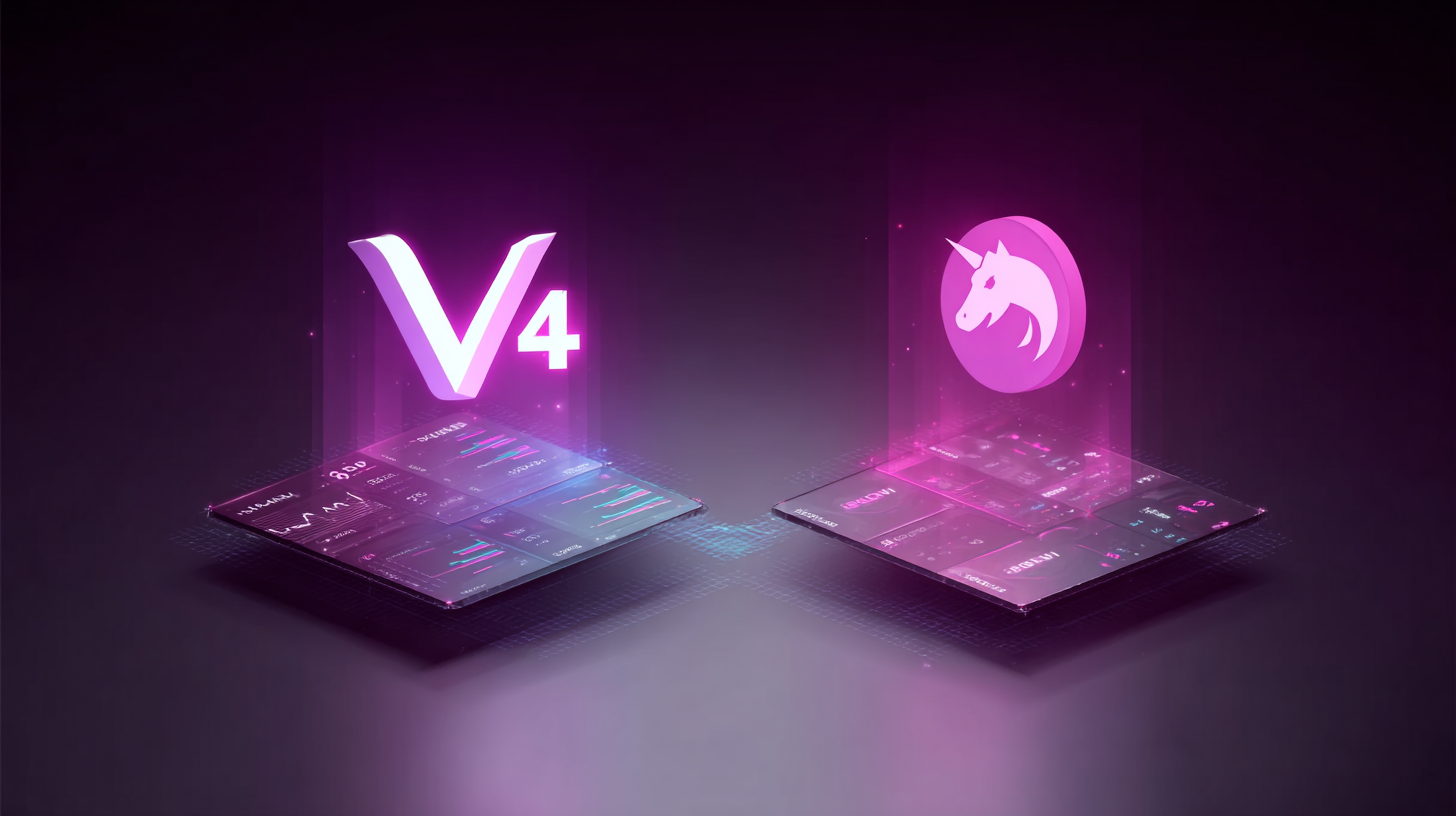
Hooks for custom pool logic in Uniswap V4 let developers add code that runs at specific points in the trading process. Hook functions can execute before swaps, after swaps, when liquidity gets added or removed, or at other defined events. The Uniswap V4 hook system enables capabilities that earlier versions simply couldn't support, including dynamic fees that adjust based on market conditions, on-chain limit orders that execute automatically when prices reach specific levels, time-weighted average market makers, and custom oracle integrations. Pool creators pick which hooks to enable when deploying new pools, with the system enforcing whatever custom logic they specify. The flexibility opens design space for liquidity provision strategies that rigid contract structures wouldn't accommodate.
Singleton Contract Design
Singleton contract design in Uniswap V4 puts all pools in a single contract rather than deploying separate contracts for each pool. The Uniswap V4 architecture reduces deployment costs for new pools dramatically, with creators paying only for the pool state instead of duplicating contract bytecode. Gas savings on multi-hop swaps come from the singleton design too, since the router doesn't need to call separate contracts for each hop in a route. Trades involving three or more pools see particularly significant gas reductions, sometimes 30-50% lower than equivalent routes on earlier versions. The architecture also enables flash accounting where token balances net out across multiple operations before any actual token transfers happen, further reducing gas costs for complex transactions.
Native ETH Support
Native ETH support in Uniswap V4 returns the ability to pool native ETH directly rather than requiring WETH wrapping that earlier versions enforced. The Uniswap V4 design lets pools hold and trade native ETH alongside any other token, eliminating the gas costs and complexity of WETH conversion for traders. The change makes ETH-paired trades cheaper and simpler since users no longer need to convert between ETH and WETH for trading purposes. Native ETH support particularly benefits Layer 2 networks where ETH is the gas token, since users can trade directly without the extra wrapping step. The feature represents a return to behavior that earlier protocol designs supported before V2 introduced the WETH wrapping pattern that became standard across the broader DEX space.
Uniswap Protocol Version History
Uniswap protocol version history covers the evolution from the initial concept through current V4 architecture. Understanding the version progression clarifies how the protocol has developed across multiple iterations.
V1 Initial Launch
V1 initial launch in 2018 established the basic automated market maker model that defined what Uniswap would become. The Uniswap V1 architecture supported only ETH-to-token pairs, with every trade routing through ETH as the common intermediate asset. The V1 design proved that constant product formulas could work for decentralized trading without order books or central matchmakers. While V1 deployment remains on Ethereum, the architecture has been superseded by later versions that support direct token-to-token trading and various capital efficiency improvements. The V1 launch demonstrated the viability of AMM-based DEX trading and laid groundwork for the subsequent versions that built the broader Uniswap ecosystem.
V2 Token-to-Token Trading
V2 token-to-token trading launched in 2020 as the version that established protocol dominance across the DeFi ecosystem. The Uniswap V2 architecture introduced direct token-to-token swaps without routing through ETH, with users able to swap between any two tokens that had liquidity pools. V2 also added flash swaps and a price oracle that other protocols could use for various purposes. The V2 deployment continues operating across all supported chains, handling some trading volume for pairs that haven't migrated to newer versions. The V2 architecture remains relevant for tokens that benefit from simpler mechanics rather than concentrated liquidity strategies that newer versions enable.
V3 Concentrated Liquidity
V3 concentrated liquidity launched in 2021 with the breakthrough that let liquidity providers focus capital on specific price ranges. The Uniswap V3 architecture dramatically improved capital efficiency compared to V2, with concentrated positions earning many times the fees per dollar deposited when prices trade within their selected ranges. V3 also introduced multiple fee tiers giving liquidity providers options based on the volatility of their chosen pairs. The V3 deployment continues processing significant trading volume across thousands of pairs even after V4 launched, remaining the standard for many pool types that don't yet need hook-based customization. Position management in V3 uses NFTs to represent each unique liquidity position with its specific price range and fee tier.
Common characteristics across Uniswap protocol versions include:
- Automated market maker model replacing order books
- Self-custody throughout every trade and position
- Open-source contracts available for independent auditing
- Permissionless access for both traders and liquidity providers
- Multi-chain deployment across Ethereum and Layer 2 networks
- Compatible wallet support across all major Web3 wallets
- Smart contract settlement directly on supported blockchains
- Continued operation through autonomous deployed contracts
- Integration with the broader Uniswap Labs official applications
- Governance through UNI token holders rather than company decisions
Uniswap Labs Product Lineup
Uniswap Labs product lineup covers the official tools that handle most user interaction with the protocol. Understanding the products clarifies how Uniswap Labs serves the broader ecosystem.
Web Application
Web application at app.uniswap.org serves as the flagship Uniswap Labs product for accessing the protocol. The Uniswap Labs web app supports all features including swaps, liquidity provision, NFT trading, and direct fiat onramps integrated into the interface. Wallet connection through MetaMask, WalletConnect, Coinbase Wallet, or other supported options takes seconds, with the application picking up the chain automatically from wallet settings. The desktop interface accommodates complex trades, position management, and analytics that benefit from larger displays. Most heavy traders prefer the web app for daily activity since the larger screen handles multiple charts and order management more comfortably than mobile alternatives.
Mobile Application
Mobile application from Uniswap Labs on iOS and Android brings the protocol to phones with a self-custody wallet built directly into the application. The Uniswap Labs mobile app handles swaps, token storage, fiat onramps, and portfolio tracking through an interface designed specifically for touch input on smaller screens. Cross-device sync through cloud backup keeps wallet addresses consistent for users running both mobile and desktop. The app stays free across both platforms with no premium tiers, monetizing through standard swap routing fees built into the protocol layer. The mobile applications serve users who prefer phone-based access to the Uniswap protocol over desktop browsers.
Browser Extension Wallet
Browser extension wallet from Uniswap Labs brings the protocol directly into the browser as a Web3 wallet alternative. The Uniswap Labs browser extension competes specifically with general-purpose wallets by offering a focused, swap-first experience that suits users primarily interested in trading rather than broader DeFi participation. Connecting to dApps works through standard wallet protocols, meaning the extension functions as a primary Web3 wallet for the entire ecosystem beyond just Uniswap itself. The extension supports the same chains as the rest of the Uniswap Labs products, with seamless network switching and integrated fiat onramps available directly within the extension popup interface.
V4 Versus Earlier Versions
V4 versus earlier versions on the Uniswap protocol shows where each version holds advantages for specific use cases. The router automatically picks optimal execution across V2, V3, and V4 pools, but understanding the differences helps grasp how the protocol evolved.
V4 Advantages Over V3
V4 advantages over V3 include hooks for custom pool logic, singleton architecture for reduced gas costs, native ETH support eliminating WETH wrapping, and flash accounting that nets balances across operations. The Uniswap V4 advantages particularly matter for sophisticated strategies that benefit from custom pool behaviors and complex multi-hop trades. V3 introduced concentrated liquidity that V4 preserves, so the capital efficiency benefits of V3 carry forward into V4 alongside the new capabilities. The V4 launch represented the largest protocol upgrade in years, expanding what's possible while maintaining backward compatibility with the broader Uniswap ecosystem of tools and integrations.
V4 Versus V2 Comparison
V4 versus V2 comparison shows dramatic architectural differences across the protocol generations. The Uniswap V4 hooks and singleton design represent fundamentally different approaches from the simpler V2 constant product architecture. V2 continues operating because its simpler mechanics suit specific use cases including memecoins, very volatile pairs, and passive liquidity provision that doesn't need active management. V4 brings sophisticated features for users wanting advanced capabilities, while V2 remains relevant for users wanting the simplest possible AMM mechanics. The coexistence of multiple versions reflects the broader Uniswap ecosystem approach where new versions add capabilities without forcing migration from older versions that still work for their specific use cases.
Version Selection Through Router
Version selection through router on the Uniswap protocol handles version picking automatically without users needing to think about it. The Uniswap router checks V2, V3, and V4 pools simultaneously, picking whichever combination offers best execution for any specific trade. Some trades execute purely on V2 because that's where liquidity sits for specific pairs, while other trades route across multiple versions when crossing version boundaries produces better total output. The unified interface treatment makes version differences essentially invisible to traders who just want optimal swaps. Users never need to manually pick between V2, V3, and V4 unless they want specific version behavior for some particular reason related to their broader strategy.
FAQ
What is Uniswap Labs?
Uniswap Labs is the New York-based company that built the original Uniswap protocol and continues developing the official interfaces. The Uniswap Labs team employs developers, designers, and researchers who advance the protocol through new versions and ecosystem improvements. The company operates independently from the protocol governance handled by UNI token holders.
What is Uniswap V4?
Uniswap V4 is the most recent major version of the Uniswap protocol, introducing hooks for custom pool logic and singleton architecture that reduces gas costs. The Uniswap V4 architecture enables capabilities like dynamic fees, on-chain limit orders, and custom oracle integrations that earlier versions couldn't support.
How does Uniswap V4 differ from V3?
Uniswap V4 adds hooks for custom pool logic and uses a singleton architecture that reduces gas costs compared to V3. V4 keeps the concentrated liquidity model from V3 while opening new capabilities like dynamic fees and on-chain limit orders through the hook system. The singleton design also reduces gas costs significantly on multi-hop trades.
Does Uniswap Labs control the protocol?
Uniswap Labs builds official interfaces and develops new protocol versions but doesn't control the deployed contracts that run autonomously on public blockchains. The protocol exists independently of the company, with UNI token holders collectively governing major changes through formal voting processes that go beyond Uniswap Labs decisions.
What is the Uniswap V4 hook system?
The Uniswap V4 hook system lets developers add custom code that runs at specific points in the trading process. Hooks can execute before swaps, after swaps, or at other defined events, enabling capabilities like dynamic fees, on-chain limit orders, time-weighted market makers, and custom oracle integrations that earlier protocol versions couldn't support.
How is Uniswap V4 different from V2?
Uniswap V4 differs from V2 through concentrated liquidity carried over from V3 plus the V4-specific additions of hooks, singleton architecture, and native ETH support. V2 uses simpler constant product pools that spread liquidity across all prices, while V4 provides much more sophisticated capabilities at the cost of additional complexity. V2 continues operating for pairs where its simpler mechanics suit the trading patterns better.
Where can users access Uniswap V4?
Users access Uniswap V4 through the official application at app.uniswap.org, the Uniswap mobile applications for iOS and Android, or through the Uniswap Labs browser extension. The Uniswap router automatically picks V4 pools for trades when they offer better execution than V2 or V3 alternatives, abstracting version selection from user decisions.